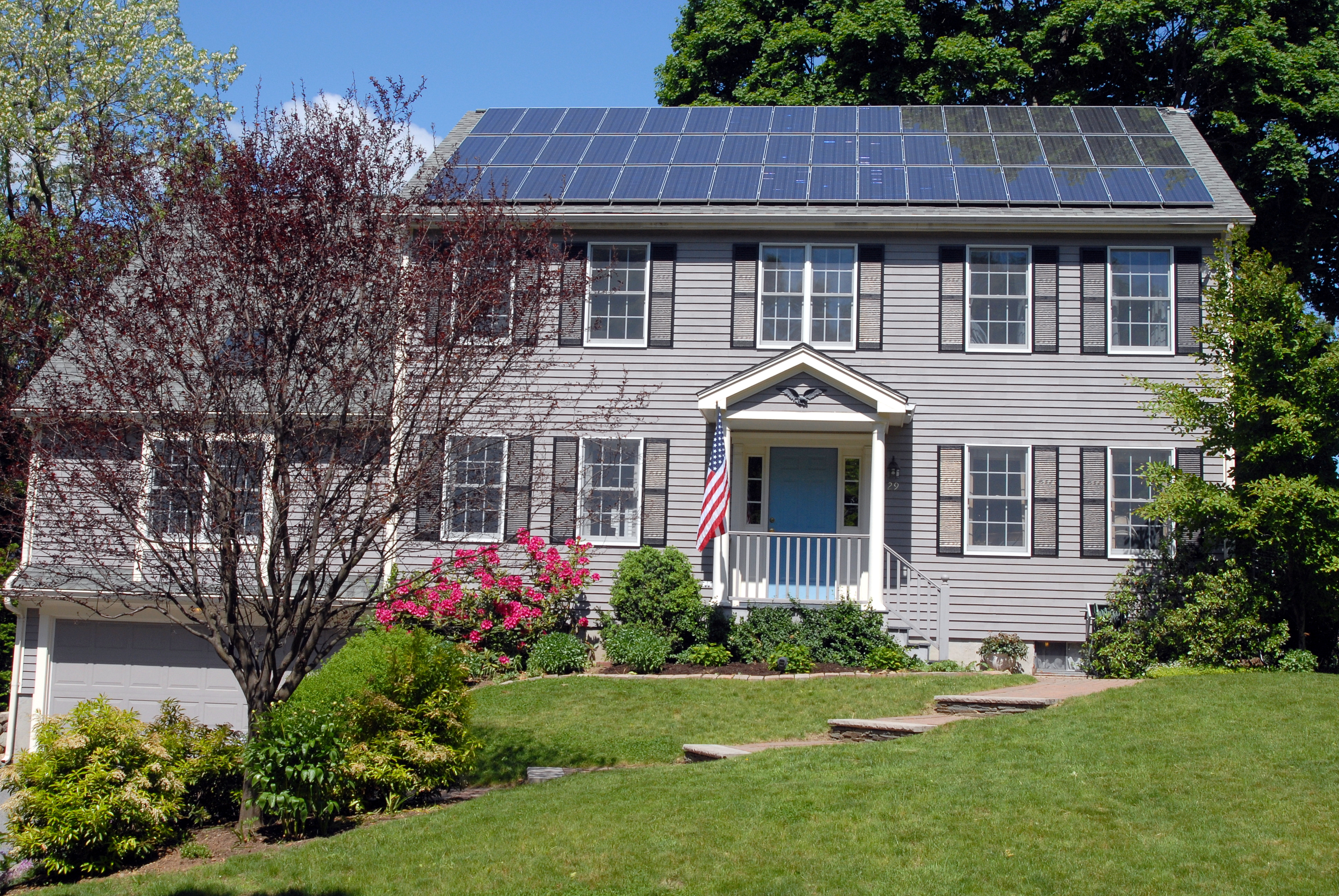
Installing solar panels on a Czech family home is a multi-step process that begins well before any panels reach the roof. Understanding what each stage involves — and what it costs — prevents surprises later. This article sets out the practical sequence, from first roof assessment to first kilowatt-hour exported to the grid.
Is Your Roof Suitable?
The Czech Republic sits between latitudes 48° and 51° N. At those latitudes, a south-facing roof pitched between 30° and 40° captures the most irradiation over the year. Southeast and southwest orientations lose roughly 5–10% compared to true south; east- or west-facing slopes lose 20–30%. Roofs facing north are generally not viable for grid-connected installations.
Shading is the other critical variable. Even a small chimney stack or dormer window that casts shadow on one or two modules during peak hours can disproportionately reduce the output of the whole array if the system uses a string inverter. A competent installer will use shade-analysis software — tools like PVGIS, provided free by the European Commission — to model annual output before quoting.
Structural load also matters. Standard crystalline silicon panels weigh around 10–12 kg/m². On a 6 kWp system that is roughly 350–420 kg distributed across 20–24 modules. Most brick and concrete-tile roofs in the Czech Republic handle this without modification; older wooden-rafter roofs sometimes need additional cross-bracing.
Panel Types Available in Czech Market
Three module types are commonly available from Czech distributors:
- Monocrystalline PERC — the current mainstream choice. Efficiencies of 20–22%, compact footprint, well-suited to smaller roofs. Most panels sold in the Czech market in 2024 fall into this category.
- TOPCon and HJT — premium monocrystalline technologies with efficiencies reaching 23–24%. Lower temperature coefficient means slightly better performance on hot summer days. Price premium of 15–25% over standard PERC.
- Polycrystalline — largely being phased out by manufacturers. Still available from some distributors at lower cost but occupies more roof area for the same output.
For most Czech homeowners, a PERC module from a Tier 1 manufacturer with a 25-year performance warranty offers the best balance of output, reliability, and cost. The performance warranty typically guarantees that the panel will produce at least 80% of its rated output after 25 years.

A ground-mounted solar installation showing panel row spacing designed to minimise self-shading. Source: Wikimedia Commons / CC BY-SA 3.0
Inverters: String, Micro, or Optimiser?
The inverter converts direct current from the panels into the 230 V AC used by household appliances and the grid. Three configurations are standard:
- String inverter — one central inverter handles the entire array. Lowest cost, simplest to maintain, but the whole string's output is limited by its weakest panel. Suitable for unshaded, single-orientation roofs.
- Power optimisers + string inverter — a DC optimiser fitted to each panel maximises its individual output before feeding a central inverter. Adds cost but significantly reduces shading losses. SolarEdge is the most widely installed brand in the Czech market.
- Microinverters — one small inverter per panel. Maximum flexibility and monitoring granularity. Higher upfront cost and more components to potentially fail. Often chosen for complex multi-plane roofs.
For a typical Czech semi-detached or detached house with a moderately shaded south-facing roof, a string inverter with optimisers is the most commonly recommended solution by certified installers.
Grid Connection in the Czech Republic
All grid-connected installations require approval from the regional distribution network operator (DSO). In most of the country this is ČEZ Distribuce, with E.ON Distribuce and PREdistribuce covering the remaining regions.
The process involves:
- Submitting a connection application (žádost o připojení) to the DSO before installation begins.
- Receiving a connection offer specifying technical conditions.
- Installation by a person licensed under Act No. 458/2000 Coll. (the Energy Act).
- Inspection and meter exchange by the DSO — typically carried out within 30 days of installation notification.
- Registration with the ERO's central registry for installations above 10 kW.
For installations up to 10 kW on a family home, the process has been simplified since the 2021 amendment to the Energy Act. Many installations in this bracket are now connected within 30 days of application.
Typical Output and Payback
Czech solar irradiation averages around 1,050–1,150 kWh/m² per year, depending on location. A 5 kWp system on a well-positioned south-facing roof in central Bohemia will typically generate 4,500–5,500 kWh annually.
At a household electricity price of approximately 6 CZK/kWh (the approximate 2024 regulated rate for a typical household tariff), and assuming 60–70% self-consumption, the annual financial saving from a 5 kWp system comes to roughly 16,000–22,000 CZK. With installation costs in the 180,000–220,000 CZK range (before any subsidy), payback typically falls between 8 and 13 years. The New Green Savings subsidy can reduce payback to 4–7 years.
Choosing an Installer
Czech law requires that installation work on grid-connected systems be carried out by a person holding a relevant energy licence from the ERO. The ERO publishes a searchable register of licensed entities. Obtaining at least three quotes, checking references, and verifying that the proposed system design includes shade analysis are reasonable minimum checks before signing a contract.
Summary
A residential solar installation in the Czech Republic is a well-defined process with clear regulatory steps. The main variables — roof orientation, shading, inverter type, and self-consumption rate — are all assessable before committing. Understanding them puts homeowners in a stronger position when evaluating installer proposals.

