
Czech homeowners installing solar panels or heat pumps can draw on several parallel funding streams — national, municipal, and EU-backed. The amounts are not trivial: on a typical 200,000 CZK heat pump installation, combined subsidies can cover 80,000–130,000 CZK. This article sets out what is available, who qualifies, and how the application processes work.
New Green Savings — Nová zelená úsporám (NZÚ)
The flagship programme administered by the Czech State Environmental Fund (SFZP) covers three areas relevant to homeowners:
- Area C — Heat sources: Heat pumps, biomass boilers, and solar thermal collectors. The subsidy for air source heat pump installation is up to 100,000 CZK; ground source heat pumps qualify for up to 120,000 CZK.
- Area C — Solar photovoltaic: A basic 5 kWp system qualifies for 44,000 CZK. Systems with battery storage receive an additional 20,000 CZK per kWh of usable battery capacity, up to a limit.
- Bonus for combined measures: Applicants installing both a heat pump and solar panels in a single application receive an additional 10,000 CZK bonus.
The programme is open to owners and co-owners of detached family houses and semi-detached houses. It is not available for apartment buildings (those are covered by a separate programme). The house must be used primarily for residential purposes.
Application Process
NZÚ applications are submitted through the SFZP online portal. The standard sequence:
- Register on the SFZP portal and create an application for the relevant area.
- Obtain quotes from at least one licensed installer. The installer must appear on the SFZP's list of verified suppliers (Zelená úsporám evidence).
- Submit the application with project documentation before installation begins (the system must not be in operation when the application is filed).
- After approval, complete the installation and submit proof of completion, invoices, and commissioning records.
- Subsidy is disbursed to the applicant's bank account, typically within 60–90 days of a complete final documentation submission.
NZÚ Light — The Simplified Track
Since 2023, the SFZP has operated a simplified sub-track called NZÚ Light for applications below a certain value threshold. Key differences from the standard track:
- Application can be submitted after installation (retrospective claims allowed within 12 months of commissioning).
- Reduced documentation requirements — no formal energy assessment needed.
- Fixed subsidy amounts per technology rather than percentage-based calculations.
NZÚ Light is particularly useful for homeowners who have already installed equipment or who find the standard track's pre-installation requirement impractical.
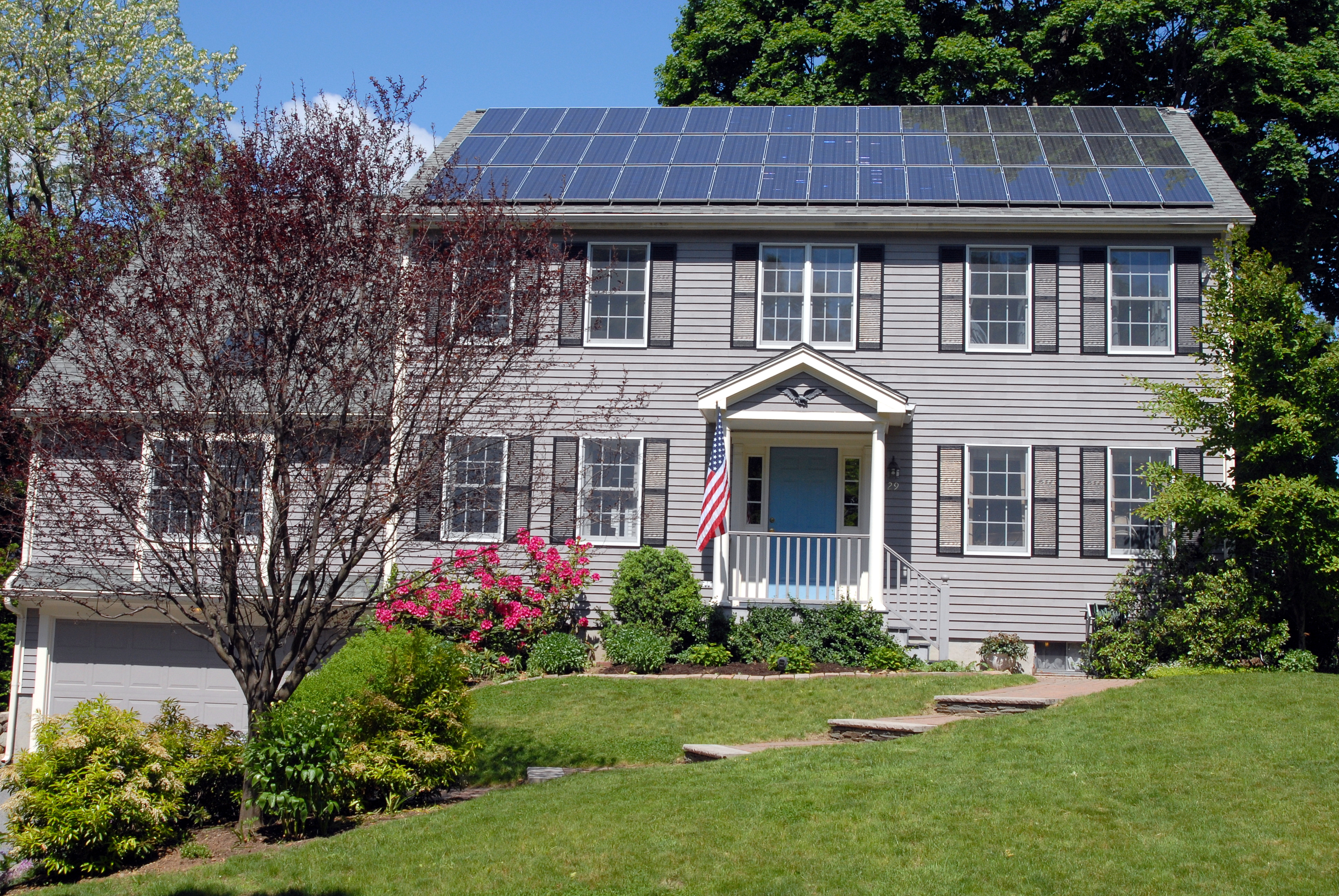
A residential rooftop solar installation of the type eligible for NZÚ subsidy support. Source: Wikimedia Commons / CC BY-SA 3.0
Municipal and Regional Programmes
Many Czech municipalities and regional authorities (kraje) operate complementary grant schemes. These vary considerably in scope, amount, and eligibility criteria. The most active programmes as of 2024 include:
- Středočeský kraj — grants of up to 30,000 CZK for heat source replacement, stackable with NZÚ.
- Jihomoravský kraj — a dedicated solar fund with flat grants of 20,000 CZK per household.
- Several larger municipalities (Praha, Brno, Ostrava) have their own renewable energy funds that top up national subsidy amounts for residents.
Municipal programmes are typically announced annually and have limited budgets that can be exhausted quickly after opening. The SFZP maintains a directory of complementary regional programmes that is updated periodically.
EU Structural Funds and the Modernisation Fund
Two EU instruments are relevant to residential renewable energy in the Czech Republic:
- Modernisation Fund: A European mechanism financed by revenue from EU ETS allowances. In the Czech Republic, a significant portion is channelled through NZÚ, meaning applicants access it automatically by applying through SFZP.
- IROP (Integrated Regional Operational Programme): Covers energy efficiency in residential buildings under Priority Axis 5. Relevant primarily for larger renovation projects that include energy efficiency measures alongside renewable energy installation.
Tax Relief
Since January 2024, Czech income tax law allows homeowners to deduct costs of energy-efficiency improvements — including heat pump installation and photovoltaic systems — from their tax base, up to 150,000 CZK per tax year. This applies to natural persons (not companies) who own and occupy the property. The deduction is claimed in the annual income tax return and applies regardless of whether an NZÚ subsidy was also received.
Stacking Subsidies: What Is Allowed
Czech rules generally allow stacking of national subsidies (NZÚ), municipal grants, and tax deductions, provided that the combined support does not exceed the actual eligible cost of the installation. The SFZP's guidance document (Závazné pokyny) specifies the maximum aid intensity by technology type.
In practice, a heat pump installation costing 220,000 CZK might receive:
- 100,000 CZK from NZÚ (Area C, air source heat pump)
- 30,000 CZK from a regional grant
- Tax deduction worth approximately 18,000–30,000 CZK depending on marginal tax rate
Total support: 148,000–160,000 CZK on a 220,000 CZK installation — net cost of 60,000–72,000 CZK.
Key Contacts and Resources
- SFZP — State Environmental Fund: administers NZÚ applications
- ERO — Energy Regulatory Office: grid connection approvals and licence register
- PVGIS: free EU tool for estimating solar output at any Czech location
Summary
Czech homeowners face a layered but navigable subsidy landscape. NZÚ remains the primary instrument, and its simplified NZÚ Light track has reduced the administrative burden for smaller installations. Municipal and regional programmes add meaningful additional support in many areas, and the 2024 income tax deduction provides a further route to cost recovery. The combination makes the financial case for heat pump and solar installation considerably stronger than the headline installation costs suggest.

