
Heat pump marketing materials tend to lead with headline COP figures — "400% efficient!" — that can be misleading when applied to actual Czech winters. This article works through what COP means in practice, how it changes across seasons, and what a realistic annual electricity bill looks like for different house types.
What COP Actually Means
COP (Coefficient of Performance) is the ratio of heat energy delivered to electrical energy consumed. A heat pump with COP 4 delivers 4 kWh of heat for every 1 kWh of electricity. That is not a perpetual-motion trick: the pump moves heat from the outside air (or ground) into the house, rather than generating it from scratch.
The problem with headline COP figures is that they are measured at a single test point, usually +7°C outside and +35°C flow temperature — comfortable conditions. Real performance varies substantially with outdoor temperature and the flow temperature required by the heating system.
How COP Changes in Czech Winter Conditions
The Czech Republic's climate zone corresponds broadly to climate zone D in European heat pump testing standards. Design outdoor temperatures (the coldest 1% of winter hours) range from -12°C in Prague to -18°C in highland areas.
At those temperatures, an air source heat pump's COP drops significantly. A unit rated at COP 4.5 at A7/W35 (7°C outside, 35°C flow) might deliver only COP 2.0–2.5 at -10°C/W55. The seasonal figure that matters for running cost calculations is SCOP (Seasonal COP), which averages performance across the heating season.
For Czech climate conditions, SCOP values for air source heat pumps typically fall in the range of:
- 3.5–4.2 with underfloor heating (low flow temperature, 35°C)
- 2.8–3.5 with oversized radiators retrofitted for 45°C flow
- 2.2–2.8 with original radiators sized for 70°C flow (older Czech panel radiators)
Ground source heat pumps (geothermal) maintain more stable source temperatures and typically achieve SCOP 3.5–5.0 even with conventional radiator systems, at the cost of significantly higher installation complexity.
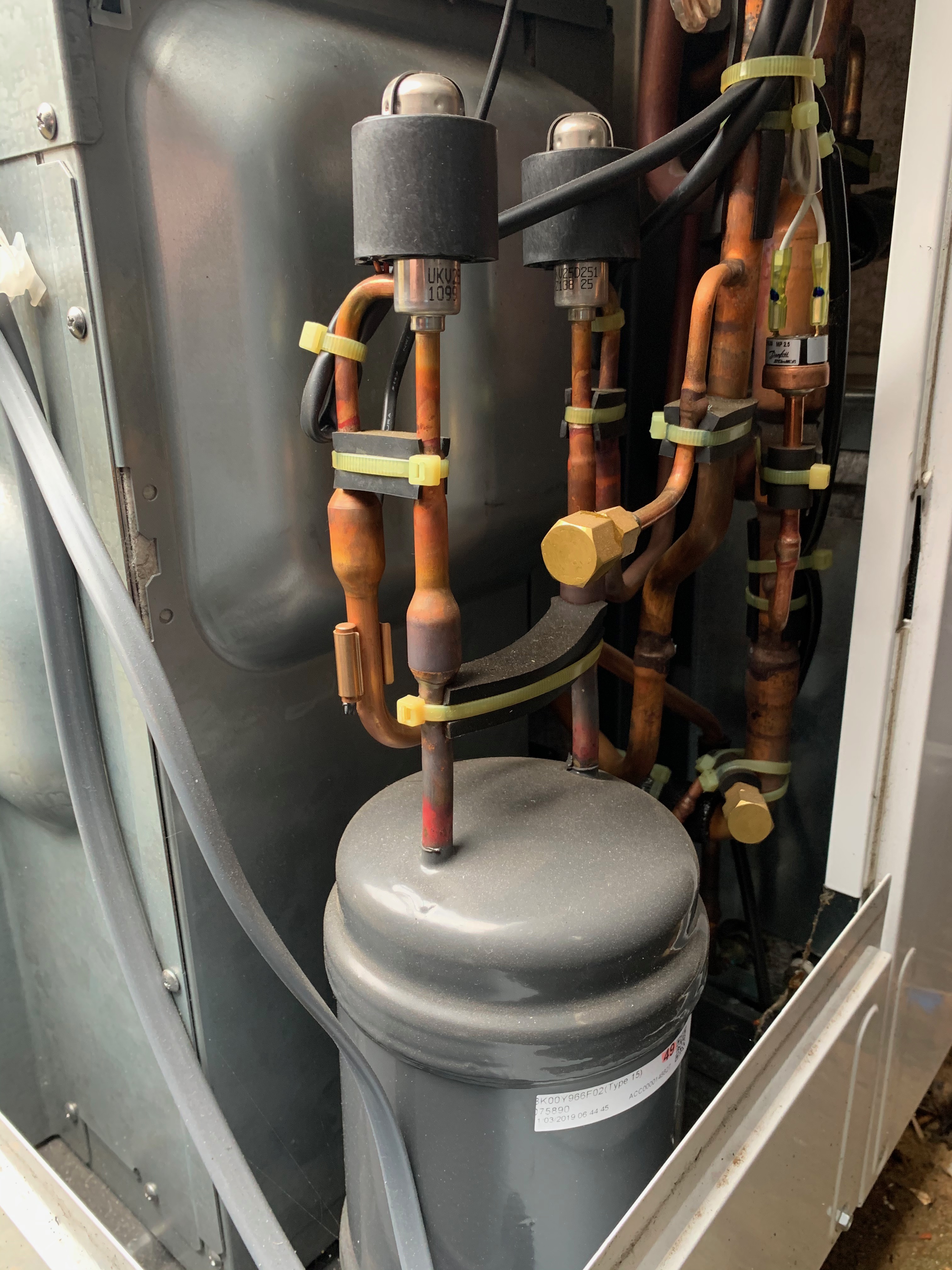
Internal components of an air source heat pump outdoor unit. Source: Wikimedia Commons / CC BY-SA 3.0
Running Cost Calculations
A typical Czech family house built before 1990 with 140 m² of living space and no major insulation upgrades has an annual heating demand of roughly 20,000–28,000 kWh. A well-insulated house built to post-2008 standards might need 8,000–14,000 kWh/year.
Using a mid-range SCOP of 3.0 for an air source heat pump installed in an older Czech house with modified radiators:
- Annual heating demand: 22,000 kWh
- Electricity consumed: 22,000 ÷ 3.0 = 7,333 kWh
- At 5.5 CZK/kWh (heat pump tariff D57d): ~40,300 CZK/year
Compared to a gas boiler at roughly 1.8 CZK/kWh of gas and 90% efficiency, the gas cost would be approximately 22,000 ÷ 0.9 × 1.8 = 44,000 CZK/year. The advantage narrows or reverses in houses where the heat pump requires high flow temperatures due to undersized radiators.
Radiator Sizing: The Key Constraint
Most Czech family houses built before 2000 have panel radiators dimensioned for flow temperatures of 60–70°C. Heat pumps work most efficiently at 35–45°C. The gap matters: running an air source heat pump at 55°C flow temperature to compensate for undersized radiators can halve the SCOP compared to a low-temperature system.
Practical options for older houses:
- Replace radiators with larger panels or fan-assisted units rated for 45°C. This typically costs 30,000–60,000 CZK depending on the number of radiators.
- Add underfloor heating in the most-used rooms. Combined with retained high-temperature radiators elsewhere, a hybrid layout can achieve average flow temperatures around 45°C.
- Accept a lower SCOP and choose a heat pump model that maintains reasonable efficiency at 55°C (some modern units achieve COP 2.5–3.0 at A-7/W55).
Air Source vs. Ground Source: A Practical Comparison
Ground source heat pumps require either a horizontal ground collector (needing significant garden area — roughly 400–600 m² of collector loop per 10 kW) or a vertical borehole (15,000–25,000 CZK per metre, typically 100–150 m deep per 10 kW). The higher installation cost is offset by better cold-weather performance and higher SCOP.
For most Czech suburban homeowners with a standard garden plot, an air source heat pump is the practical starting point. Ground source makes sense when the garden is available, the house has high heating demand, or when long-term operating costs outweigh the additional capital.
Combining With Solar Panels
A heat pump's annual electricity consumption of 5,000–8,000 kWh fits reasonably well with a 5–8 kWp rooftop solar installation. The challenge is timing: most heating demand occurs in winter when solar output is lowest, and most solar generation happens in summer when heating is not needed. Hot water production via the heat pump during summer months can absorb some surplus solar generation. A battery storage system (typically 5–10 kWh usable capacity) can shift daytime solar surplus to evening heating use.
The NZÚ subsidy programme covers both heat pump and solar installations, with bonus points awarded for combined applications.
Summary
Heat pump running costs in Czech conditions depend heavily on the SCOP achieved in practice, which in turn depends on the flow temperature the existing heating system requires. A house with low-temperature distribution (underfloor or oversized radiators) will see clear running cost savings over gas. An older house with original radiators requires investment in distribution upgrades to make the economics work. Both scenarios can qualify for significant subsidy support.

